


From $50 Million Champions to 44% Disengaged Fans – What the Numbers Reveal About FIFA World Cup 2026


We are a little over two weeks away from the beginning of the FIFA World Cup 2026, the most anticipated football event of the year. Taking place in Canada, the USA and Mexico, this will be the first-ever tournament to include 48 teams, which means there will be more matches than before. Even though countries here compete mainly for glory, the recently revealed prize pool definitely adds to the excitement because FIFA increased it dramatically.
According to Nostrabet.com, the winners of the 2026 World Cup will get close to $50M. While the numbers are staggering, they don’t seem to affect how people feel about the event in some countries. This raises the question of whether financial growth and commercial success guarantee public engagement. It’s definitely an interesting topic, so let’s take a look at what you should know.
The Biggest World Cup & Prize Pool Ever
As mentioned, the 2026 FIFA World Cup will be the largest to date, with 48 teams in the new format. There will be a total of 16 more nations than before, which results in more teams and more matches. Needless to say, FIFA expects this to generate revenue through broadcasting rights, sponsorships, tickets and merchandise sales.
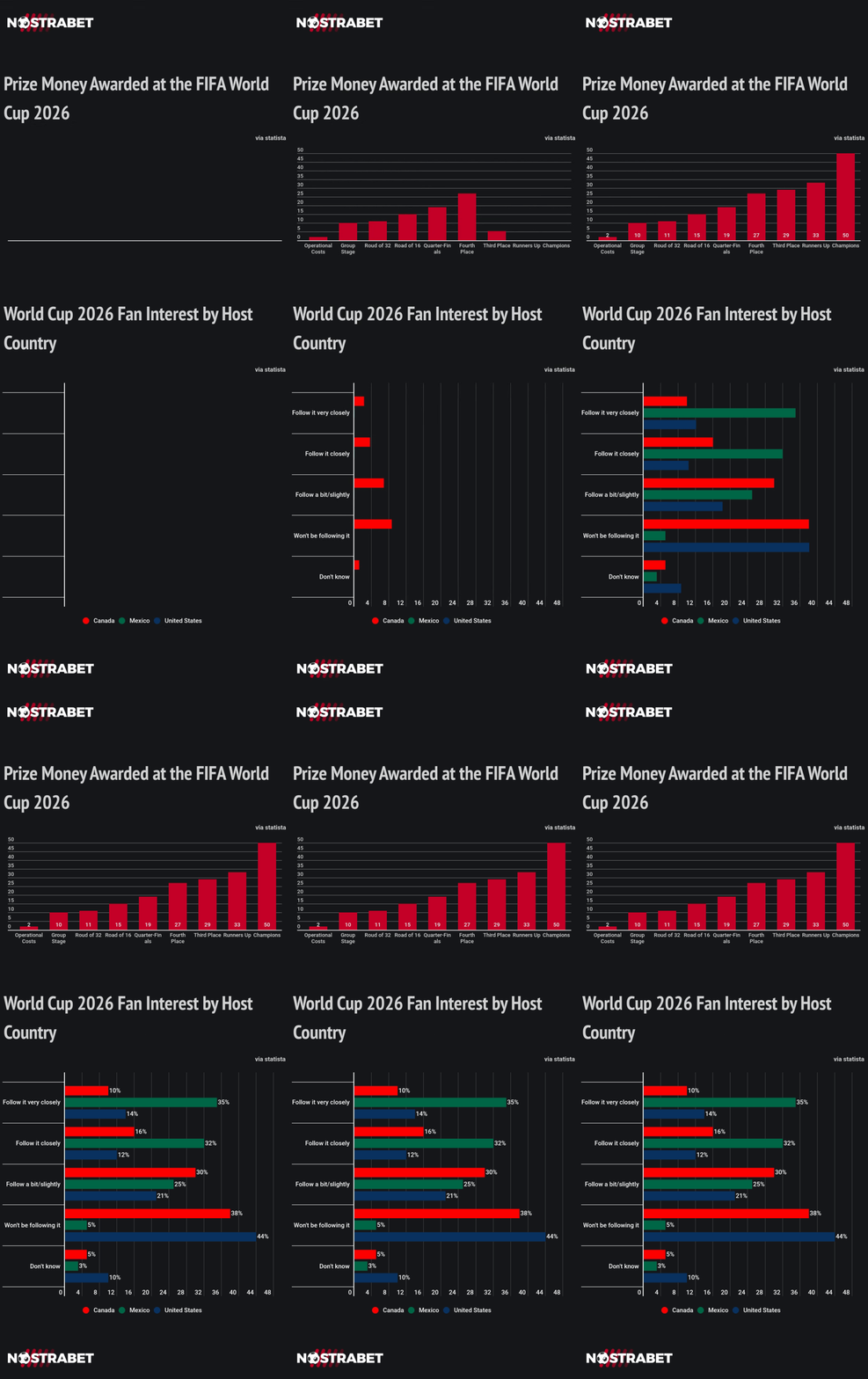
Alongside the new format, which includes more teams, the tournament’s governing body also changed the prize pool. FIFA revealed the new prize pool distribution, and it became clear that the winners will receive $50M. Even teams eliminated early will receive substantial financial compensation. Here is an overview of the complete prize pool:
| Tournament Stage | Prize Money (USD Millions) |
| Operational Funding | 2.5 |
| Group Stage | 10 |
| Round of 32 | 11 |
| Round of 16 | 15 |
| Quarter-finals | 19 |
| Fourth place | 27 |
| Third place | 29 |
| Runner-up | 33 |
| Champion | 50 |
All of these figures demonstrate that the tournament’s financial scale has increased dramatically. FIFA wants to make sure teams are more motivated than ever to achieve their big goal. Many experts agree that the organization’s financial distribution reflects the commercial success of the expanded competition.
Why the $50M Prize Pool Matters?
As mentioned, the big prize pool for the winning nation is more than just a headline grabber. It is a symbol of the event’s growing commercialization of football and the increasing value of these kinds of sports events.
When compared to previous World Cups, FIFA has increased the numbers drastically. According to the organization, the reward is justified because it believes that the 2026 World Cup has huge revenue-generating potential due to the expanded format.
What many people don’t realize is that these amounts of money can be transformative for a lot of teams. Many smaller countries can use the funds to invest in youth programs, coaching initiatives, and even infrastructure. While some of the more wealthy countries don’t rely on FIFA’s financial distributions, others do.
As I have shown you, every single round that a given team reaches means a higher reward. This creates both sporting and economic motivation for everyone playing.
The Other Side of the Story – Fans’ Interest is Uneven
There is no denying the 2026 FIFA World Cup will be unique, but it seems not everyone is as excited about it. Based on a survey that took place in the three host nations, there is a big difference in the World Cup engagement.
In Mexico, for example, 35% have said that they would follow the FIFA World Cup very closely, whereas 32% said they’d follow it closely. For comparison, only 14% of people answered they’d follow it very closely in the USA and 12% plan to follow it closely. Lastly, we have Canada, where 10% plan to follow it very closely and 16% planned to follow it closely.
All of these stats clearly show that Mexican fans are the most excited about the upcoming event. The difference between the three is even clearer when you check the “I won’t be following at all” category. Only 5% of Mexicans said they won’t follow it at all, whereas the percentage in the USA is 44%, and Canada is next with 38%.
30% of Canadians said they’ll be following it slightly, and 5% said they don’t know. 25% of Mexicans and 21% of Americans also answered they will follow it slightly, and only 3% of Mexicans and 10% of the US fans said they do not know.
All of these stats come following we revealed the biggest concerns about the competition among the host countries. With that said, the current statistics show that fans in Mexico are ready to embrace the tournament. Judging by the stats, this may not be the case in Canada and the USA. But why is that? Well, let’s analyze the situation in each of the three host nations.
Mexico’s Deep Football Culture
There is absolutely no denying that Mexico is the country where football is much more popular than in Canada and the USA. This is the most popular sport in Mexico, and the national team enjoys huge support. The same is true for the domestic leagues.
Given football’s popularity, the World Cup is very important to locals. It represents more than just an economic opportunity because it’s also a cultural celebration. Mexican fans definitely have an emotional connection to the tournament, and many people believe the event is a part of their national identity.
Why Canada Appears Less Engaged
Compared to Mexico, fans in Canada seem to be less engaged, which is weird, considering that the country will host World Cup matches for the first time. While research shows that Canadians support the idea of hosting the World Cup, it seems like they are not deeply invested in the tournament itself.
This may surprise some of you, but several factors explain the situation. For starters, football is simply not the most popular sport in the country. Even though the “soccer” participation rate has increased significantly lately, the sport remains far less popular than hockey.
The second reason is that Canada simply does not have that much World Cup history. Unlike Mexico, it lacks generations of World Cup memories, and this has an effect on fans’ interest.
Overall, it seems like fans must feel connected to the competition. Being a host country on its own is not enough to generate a lot of enthusiasm, and this shows why 44% of Canadians do not plan to follow the event at all.
The United States – A Huge Market with Potential
Some of the aspects mentioned about Canada also apply to the US. Football is also not the most popular sport, but there is no arguing that it has grown massively in the last couple of years. Major League Soccer has expanded and includes multiple young and world-class players. Even Lionel Messi, Argentina’s living legend, is playing there.
Despite all of that, the survey clearly shows that many Americans still remain indifferent toward the World Cup. People simply prefer other sports, such as American football, basketball and baseball.
Unlike Canada, however, the United States has a massive population and media market. As a result, even events with a moderate engagement level can translate into enormous audiences and huge commercial success.
The real challenge in the USA is for FIFA to “convert” casual observers into long-term fans. This seemed really difficult before, but considering how things are changing, I would not be surprised if football becomes one of the most popular sports really soon.
So, Can Money Buy Interest?
Generally speaking, there is always a connection between financial investment and fan engagement. I believe that the $50M champion’s prize clearly shows that FIFA is committed to making the tournament “financially appealing” for everyone. This also includes people who may not be that interested in football.
With that said, I personally don’t believe that money can buy interest when it comes to this sport. Football has been around for ages, and people in specific countries either like it or they don’t. The idea of people watching a big football event just because it offers a high prize pool isn’t really a thing, unlike in esports. Many games like Dota 2 and Fortnite became extremely popular in the last 10 years, mainly because of their huge prize pools that attracted millions of new fans.
World Cup’s Commercial Future
Considering the size of the 2026 World Cup and FIFA’s approach towards the prize pool, the organization expects unprecedented revenues. There will most likely be increased sponsorship opportunities, larger broadcasting contracts and more ticket sales than before, and all of that will contribute to. However, we will have to wait until the competition is over to see if this will really be the case.
Achieving sustainable growth requires expanding football culture in these kinds of markets. If a large portion of the host country remains indifferent, FIFA will have to step up its game even more to change that.
Overall, the stats surrounding the FIFA World Cup 2026 tell a fascinating story. The tournament has reached unprecedented financial heights because the winners will get $50M. There is also an increase in the financial rewards for participating nations, and when you also add the new format, FIFA has basically created the most commercially valuable World Cup so far.
With that said, the fan engagement across the host countries remains uneven. It will be very interesting to revise all the popularity stats once the competition is over to see how they change. The statistics from the US and Canada will most likely depend on how well the host countries perform.
No comments added yet. Be the first!