


How Sports Betting Became the Engine of Prediction Markets – The $15.5 Billion Surge



Some of you may remember the days when prediction markets were promoted mainly as forecasting tools. It is safe to say that those days are long gone because the Nostrabet.com team and I found that people bet millions using the most popular prediction market platforms. Users have the opportunity to wager on all kinds of things, and many choose politics, inflation, and economics. That said, it seems sports are the most popular, at least according to the latest stats.
The two leading prediction market platforms (Polymarket and Kalshi) generated nearly $15.5B in sports contracts in April 2026. As you can imagine, the number is extremely impressive because it equals to 65% of the total amount. Overall, April was an amazing month, with both platforms generating a total of $23.8B.

All of this data means that sports have become the engine behind prediction markets. It’s definitely an interesting topic that needs deeper exploration, so let’s learn more about it.
The Concept Behind Prediction Markets & The Biggest Predictions So Far
We all know that sports betting requires you to risk your money to try to predict a specific outcome. Prediction markets, however, work differently because they use contracts. Typically, a contract pays $1 if a stated outcome occurs and $0 if it does not. Before settling it, the price can be interpreted as a market-implied probability. In other words, if a contract is trading at 60 cents, it means that there is a 60% perceived chance.
In terms of structure, the big difference is that people who use prediction markets can buy or sell a given position before the outcome is known. This means people always have access to the Cash Out feature in sports betting.
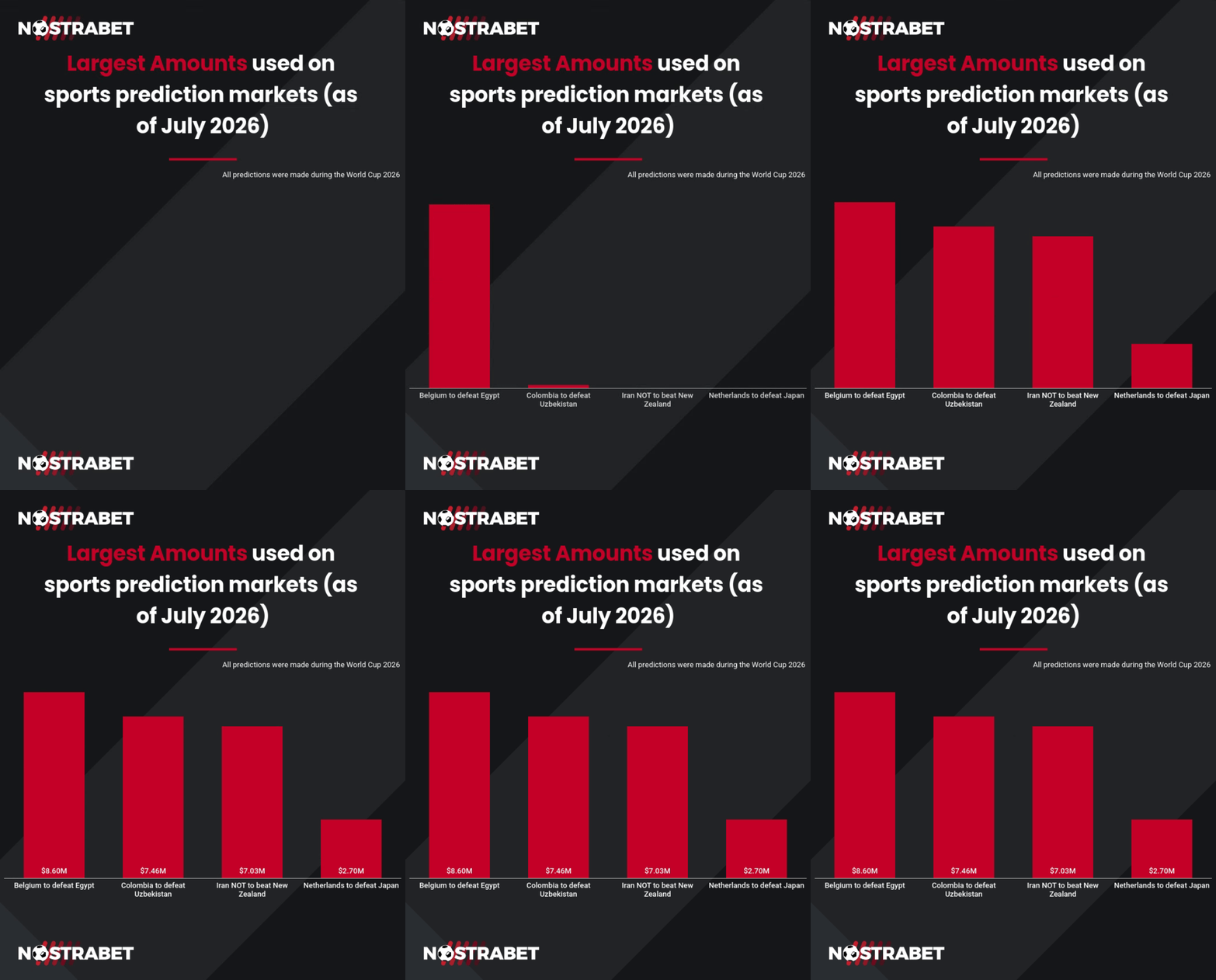
When it comes to the biggest predictions so far, the stats are truly jaw-dropping. As of early July 2026, a user named LEEROY JENKINS (I can spot the World of Warcraft fan) used $8.60M on the market that Belgium would defeat Egypt at the 2026 World Cup. The potential payout here would have been around $13.14M, but sadly, it did not work out. The two teams ended the match in a 1-1 draw, and the user failed to predict the market.
The next few top picks at Polymarket are also related to the 2026 World Cup:
- endlessFate decided to use $7.46M that Colombia would beat Uzbekistan. The player was successful and got approximately $10.17M.
- Mindblade tried his luck that Iran would NOT beat New Zealand and added $7.03M. He was successful and ended up with $7.34M.
There are also a few “smaller” predictions between $2.7M and $1M on the World Cup 2026. This proves sports are crucial for prediction markets.
The World Cup Effect on Prediction Market Activity
The 2026 World Cup is an excellent example of why sports contracts have the power to generate enormous volume. As I have shown you, some users staked millions on it, and this is not surprising. A competition of this size attracts attention from fans worldwide, and it offers many matches to bet on.
Each game creates new opportunities for users to trade on team results. This is especially true when there are multiple high-profile fixtures, as they even attract casual participants.
It will be interesting to see what happens once the World Cup is over. Some people believe that sports could lose momentum.
Why Sports are So Good for Prediction Markets?
If you think about it, sports give prediction markets what they need. There is a constant supply of clear events that everyone understands. For comparison, there are not that many elections around the world and economic-related options are harder to understand for the general audience.
On the other hand, sports deliver a constant stream of matches and events. Most contracts settle quickly and give participants a reason to return, something that does not happen a lot.
Besides all of that, sports are also data-rich, and fans can check all kinds of things before making their predictions. All of these facts can move prices, and this makes everything more interesting.
Last but not least, sports bring a “ready-made” audience, especially in the USA. Based on the stats from the American Gaming Association, bookies in the country handled more than $166.94B in bets in 2025 alone. This means that many people are familiar with sports betting and would gladly put their luck to the test in the prediction markets.
What do the April 2026 Figures Reveal
As you can see in the chart, sports clearly dominate the April 2026 figures. The stats clearly show that sports volume is $15.5B, which is almost 6 times more than the $2.7B traded in politics. It is also five times more than the $3.2B people traded in cryptocurrency. Sports even outshines the “other” contracts, which include pretty much everything else you can think of ($5.6B in total).
All of these numbers reveal one crucial thing – prediction markets are flourishing. A quick look at the statistics from September 2025 reveals that Kalsi and Polymarket combined had a global volume of below $5B. Moving to April 2026, that volume is now at $24B, and this even excludes Polymarket U.S.
Sports, politics and cryptocurrency make up over 90% of the global volume of both platforms. In fact, sports seem to be more important for Kalsi because they account for 80% of its volume since July 2024. For comparison, sports were “only” responsible for 39% of the volume on Polymarket.
How Sports Betting Drives Liquidity and Participation
The big advantage of sports in prediction markets is liquidity. People have the chance to buy or sell quickly because there are a lot of other participants doing the same. Users can enter when they feel the price is wrong and exit when they have enough information.
Unlike everything else, sports produce a regular stream of market-moving information. The prices usually react to a lot of things, such as injuries, team selection and even the weather. There are also loads of in-game stats that can shift momentum and prompt immediate reassessments.
Another big advantage of sports in prediction markets is that it attracts casual fans seeking entertainment. Alongside them, sports are also appealing for experienced bettors who use data, as well as traders who look for price differences. These groups of people can create more transactions and more responsive prices.
The Blurred Boundary Between Prediction Markets and Gambling Products
If you are following the news around prediction markets, the biggest debate is whether they are actually gambling products. Many U.S. states are preparing to or considering changes to their legislation so that prediction markets will be subject to the same rules as other gambling products.
It is up to all policymakers to decide whether sports event contracts should be treated as financial or gambling products. Some experts believe they are a hybrid and require safeguards from both systems. According to the CFTC, the designated contracts markets certified an average of around 5 contracts a year between 2006 and 2020, whereas the number reached 1600 for listing in 2025. This clearly shows that these things are becoming much more popular and require clearer rules.
Assuming such rules become a reality, consumer protection must be regulated. Platforms will need to step up their game and require age and identity checks. They will need to have clear rules and explanations, as well as a way to identify suspicious or harmful patterns of use.
The Risks of a Sports-Led Prediction Market Boom
Although the rise of sports contracts drives growth, it also poses a risk that prediction market platforms cannot ignore. The biggest one has to be that people are often encouraged to trade more than they otherwise would.
As mentioned, sports offer way more options, so fans have a lot more to pick from. People interested in prediction markets must recognize the risks involved and avoid chasing losses or acting impulsively. This is one of the main reasons these sites should add options that let people control how they play.
Another issue many do not talk about is how sites present these products. They use terms like contracts, probabilities and trading, but the truth is that almost everyone sees them as another way to wager on matches. This is the main reason many believe sports-based contracts should follow different gambling rules.
Closing Thoughts
All in all, sports have become the engine of prediction markets because of what they offer. People recognise that events and sports have passionate communities, and there is a constant flow of information that can move prices. As shown, the sports volume in the prediction market is way higher than any of the other categories.
Sadly, the success of sports also creates the biggest problem for the industry. Sport-based contracts could be one of the fastest and most financial-sounding form of betting, so people need to be careful. This will definitely be one of the most interesting topics for the remainder of 2026, and we expect to see clear regulation really soon.
No comments added yet. Be the first!