


Brazil’s Betting Boom – 40 Million Bettors, a $4 Billion Market and a Nationwide Ban


Aside from being the largest country in South America, Brazil is (or was) a key player in the online sports betting industry. The country opened its regulated market in 2025 and quickly became one of the largest ones. However, just two years after that, Brazil is preparing to switch that market off.
Based on the findings from the Nostrabet.com team and me, President Luiz Inácio Lula da Silva signed Provisional Measure No. 1,394 on September 25, 2026, that effectively bans fixed-odds betting in the country. The act affects both online games and sports betting and involves offers from foreign companies to people in Brazil.
Unsurprisingly, this controversial decision faced serious backlash from community members. The stats show that there are more than 40M actively registered people in the country’s national betting management system. Moreover, the online betting sector generated billions in tax revenue.
It’s interesting to follow Brazil’s journey from the world’s most promising regulated market to a nationwide ban and see what could happen next. Let’s dive in.
Building the Major Regulated Betting Market in Just 21 Months
Some of you may not be aware, but fixed-odds sports betting was technically legalized in Brazil in 2018. Despite that, locals had to wait until Law No. 14,790, enacted in December 2023, came into effect because it involved both sports betting and online casinos.
Following the many discussions, January 1, 2025, marked the beginning of the operator’s ability to work in the country. They had to obtain a permit from the Secretariat of Prizes and Betting, and each authorization cost R$30M and allowed companies to hold up to 3 brands.
Just 8 months later, the Ministry of Finance reported that more than 85 companies had received licenses. They made total payments of R$2.55B, but the regulated national system existed for only 21 months because MP 1,394 prohibited it.
More than 40 Million Active Registered Clients
Brazil is a huge country, so it’s probably not surprising that online sports betting reached millions of people. Based on the data from August 2026, there were more than 40M active registered players.
This number is exceptionally high, which is why the government already started tightening access before introducing the ban. There were special measures that no longer allowed around 800K people to bet because they had renegotiated their debts. An additional 3M people from the Bolsa Familia and BPC beneficiaries were blocked, and the country’s self-exclusion platform recorded more than 1.2M requests.
All of these measures reduced the total percentage of bettors in Brazil by around 5 million.
A Market Worth More Than $4 Billion
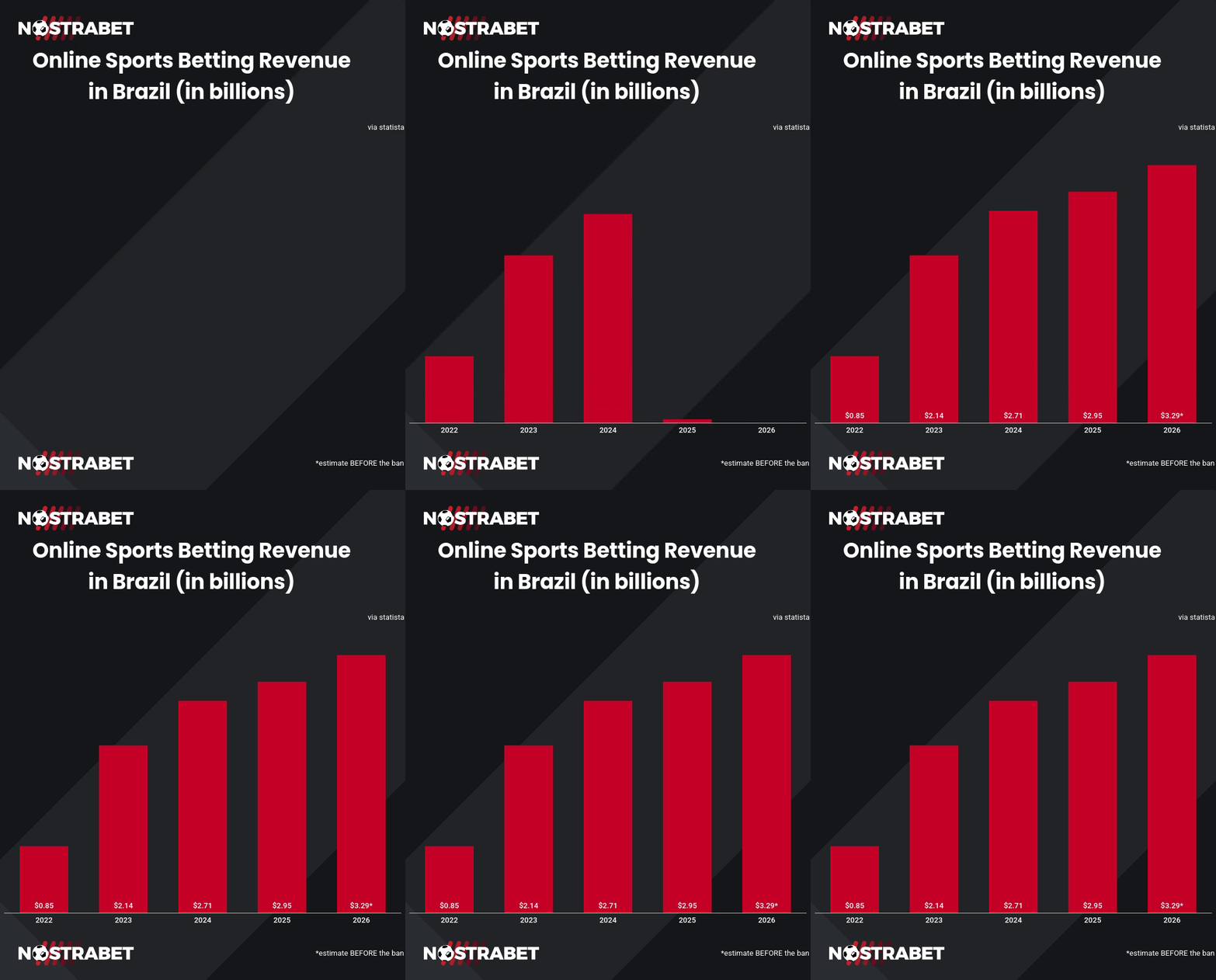
According to statistics from outlets such as the Associated Press, Brazil’s online betting sector generated over $4B in 2025. This was the country’s first full year of the regulated national market, so the numbers for 2026 would have been even higher. However, the most recent ban will probably change that.
Speaking of the ban, the government said on October 2, 2026, that around $1.456B in people’s funds were monitored for withdrawal. This amount was split among 28.65M CPF accounts with a positive balance. An interesting fact is that the amount is 30.99% less than what it was on September 26.
Brazilian Football and its R$1 Billion Betting Problem
Football in Brazil is definitely the sector that suffered the most from the President’s decision to ban sports betting. According to Reuters, betting companies in Brazil generated around R$1B in advertising revenue for local football clubs in 2025 alone. Just to give you an idea, this is about 10% of their revenue.
The exposure of betting companies in football goes beyond shirt sponsorships. You can find betting companies in different stadium boards, digital campaigns, promotions, and other kinds of commercial agreements.
Considering all that, the ban will have a significant impact on the financial situation of many teams. Reuters further reported that many will have to cut jobs, reduce salaries, and even sell players if this revenue stream stops. Sure, there will be other companies willing to sponsor the big teams, but R$1B is a lot, and it will take time to replace that source of income.
So, What Does MP 1,394 Actually Ban?
Based on the information we have, the measure prohibits offering, intermediation, exploitation, and advertising of fixed-odds betting in Brazil. In other words, it applies to both sports betting and online games and affects foreign operators located in Brazil.
On top of all that, the government decided to terminate the existing federal fixed-odds betting authorizations. According to the official guidance, operators will not receive any compensation for their lost profits or investments. To make matters worse, the R$30M they had to pay as the authorization fee will not even be refunded automatically.
Players have until October 5, 2026, to request their withdrawals directly from the bookmaker. Starting on October 6, all betting sites and apps must become unavailable, and operators have to report their balances to Brazil’s financial institutions by October 8. Banks will have until October 14 to return the remaining funds to players.
The MP 1,394 is a provisional measure with immediate legal force, but it must survive the legislative process to remain in effect. Needless to say, many betting companies decided to challenge the new measure in Brazil’s Supreme Court. There can also be intervention by Congress, so the market’s final legal structure remains unresolved.
Operators Are Already Counting the Cost – Could the Ban Push Bettors Offshore?
As mentioned, some of the major international betting operators available in Brazil have already commented on and taken action against the new measures. Brands like Flutter have estimated that this ban would reduce their revenue by around $70M because the country accounts for 1% of their 2025 revenue. Entain is another company that is “exposed” to Brazil’s market because the country was expected to account for around 5% of its net gaming revenue in 2026.
One of the biggest downsides of the new ban is that it may force people to focus on offshore operators. Brazil spent years building a system that is based on licensed sites, identity checks, self-exclusion, payment monitoring, and enforcement against illegal sites. Sadly, the removal of licensed operators does not mean consumer demand disappears.
Speaking of offshore operators, the stats show that authorities have requested the removal of around 5,200 illegal betting domains by September 29. Authorities also wanted to remove many betting apps and the social media pages of illegal operators.
Assuming that the ban becomes a reality, it will be really hard for local regulators to keep track of everything. Betting operators can be very innovative when targeting people in a specific country. The fact that all of these sites will operate outside Brazil means the latter won’t earn any revenue from them.
Could Other Countries Follow Brazil’s Example?
It’s important to know that Brazil’s President has had a clear stance on online sports betting for some time now. Most people did not expect the ban to actually happen, but some weren’t surprised, especially if they followed his interviews.
Brazil’s drastic decision could pave the way for other countries to do the same and introduce a ban. As of now, no markets are on the verge of doing that, but some are definitely closer than others.
India, for example, already has legislation that prohibits online money games, advertising, and related payment processing. Australia is also an interesting example because the country has imposed many restrictions in the last couple of years. January 2027 will mark the beginning of a ban on wagering advertising during live sport and in sports venues. There will also be more control over gambling ads.
The Netherlands and the UK are also two countries worth mentioning. While neither of them will probably ban betting, they have introduced stricter rules regarding it. However, we would not be surprised if even more drastic measures are taken in the next couple of years, especially in the Netherlands. The country prohibited online gambling operators from sponsoring sports clubs and competitions in 2025.
What Happens Next?
Brazil experienced one of the most significant betting booms in recent years. Due to the country’s sheer size, there were over 40M active players, and the industry generated close to R$4B in 2024 alone. The country built all of that around a regulated market, but now it is trying to dismantle it.
Right now, Brazil’s online betting industry is in a weird place because no one knows what will happen. Yes, the ban was introduced a few days ago, and new deposits have stopped, but many betting companies are already taking legal action. Many of the country’s top football clubs also have a firm stance against that and will take action.
After years spent trying to regulate a huge betting market, the country is now determining whether to switch it off. We will make sure to keep track of everything going on.
No comments added yet. Be the first!