



Having an online business has never been easier than it is in 2026. You can build your website and start offering a product or service in a matter of seconds. Sadly, this does not mean that what you do will be risk-free because there are many cyberthreats waiting for you, especially if you have an online betting business.
Considering we at Nostrabet.com have been in the iGaming industry for over 10 years, we know a thing or two about these cyberthreats. Some things have been around for many years, whereas others are new, but all of them are just challenges that online betting sites may have to face. In fact, we think that almost all online businesses go through at least some of these issues, so let’s learn more about each one.
1. Phishing, Vishing or Smishing Attacks
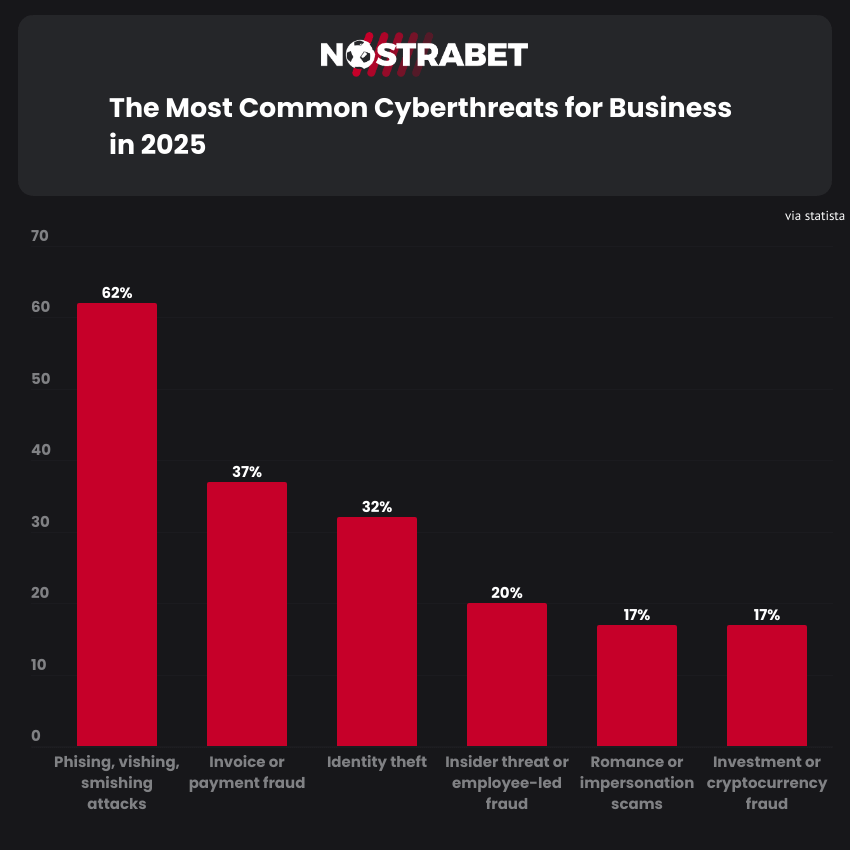
Our tests and analysis indicate that phishing, vishing, and smishing pose the greatest cyber threat to online betting sites in 2026. Studies back this up because over 62% of the cyber attacks in 2025 were caused by one of these three things.
Among the reasons why these attacks are prevalent is that gambling platforms handle a lot of financial transactions and sensitive data. Criminals are aware of it and want to impersonate betting brands and payment providers. The end goal is to lure clients into sharing their login credentials so that the criminal can steal their data and money.
What’s unique about online betting operators is that phishing not only affects customers. It also impacts staff, including traders, affiliate managers, and VIP account holders.
We have noticed that most phishing campaigns surge during major sporting events. Smishing attacks usually lure users with fake bonus offers. Vishing attacks, on the other hand, exploit users’ trust by posing as “fraud prevention teams” who usually call someone to verify a suspicious betting activity.
Needless to say, online betting operators are doing what they can to battle these three issues. Many have advanced email and SMS filtering, as well as multi-factor authentication. Some sites even started offering customer education campaigns.
2. Invoice or Payment Fraud
Invoice and payment fraud is another growing threat to online betting operators. Our observation shows that this is especially true for sites that expand globally and work with multiple payment processors. The stats also back it up because, in 2025, around 37% of all cyberthreats were related to one of the two.
This form of fraud usually involves attackers manipulating payment institutions. Most people would assume that payment fraud is limited only to the internal accounting department, but this is not the case. Attackers can also exploit weaknesses in withdrawal systems. We also noticed that these attacks are more common on sites that allow cryptocurrency payments. They are popular but add another layer of risk because transactions are irreversible and harder to trace.
Sadly, we expect these two frauds to continue to be a thing in 2026. In fact, we believe criminals will increasingly use AI-generated emails and forged documentation. Betting operators will have to adopt strict segregation of duties and multi-step payment approvals. They also have to invest in educating their staff about all of these dangers and teach them what to do when they realize something is off.
Keep in mind that gambling regulators are also paying close attention to financial controls in the gambling industry. We would not be surprised if they decide to “take matters into their own hands” and require sites to meet specific standards.
3. Identity Theft
To be fair, identity theft is not the most common cyber threat that online betting sites face. However, it remains a serious challenge for these businesses, especially due to the strict Know Your Customer and anti-money laundering requirements. It seems like this also affects other online businesses because around 32% of them had to deal with this issue in 2025.
What some people don’t realize is that identity theft creates multiple risks for gambling operators. Besides distorting betting markets and triggering chargebacks, this can expose platforms to regulatory penalties. Needless to say, people can lose trust in a given site if they become victims of identity theft.
Many modern online betting platforms are doing what they can to mitigate identity theft. Some of them invest heavily in security features, such as identity verification systems. These things combine document checks, biometric analysis, device fingerprint, and even behavioral monitoring. Overall, we think continuous authentication will become essential in 2026 and that more and more sites will offer it.
4. Insider Threat or Employee-led Fraud
Our experience shows that online betting operators often underestimate insider threats. Despite that, they pose a unique and potentially devastating risk, and 20% of online businesses have dealt with these issues before.
Employees, contractors, and even freelancers may have privileged access to betting systems, customer data and other key information. If these people want to conduct fraudulent activities, they can manipulate the odds, leak sensitive data, approve suspicious withdrawals, or even sell customer information. Needless to say, online betting operators must be extremely careful, as even a single compromised account can result in substantial financial losses and long-term reputational damage.
It is worth noting that not all insider threats are malicious. As we mentioned earlier, it is possible for employees to fall victim to phishing attacks. That’s why it is very important to educate everyone about how these industries work and what they need to do.
We expect online betting sites to step up their game and monitor everything closely in 2026. Things like real-time activity monitoring and role-based access controls could be around the corner.
5. Romance and Impersonation Scams
Generally speaking, romance and impersonation scams are rampant among most online businesses, and the statistics back it up. Around 17% of all companies have had to deal with at least one of these two issues in 2025. Needless to say, online betting companies are also affected by them.
These are the schemes where criminals built trust with victims and then encouraged them to gamble or transfer funds between accounts. It is also common for scammers to impersonate professional bettors or tipsters and promise big wins in exchange for deposits or access to betting accounts.
As you can imagine, betting sites suffer a lot from these problems. The scams can lead to a surge in disputed transactions, complaints and chargebacks. It is also common for victims to accuse operators of facilitating fraud, which draws regulatory attention and damages brand reputation. It is also worth noting that impersonation scams can target betting sites directly, using fake social media profiles and even replica websites.
Something that we should be careful of is the growing influence of AI-driven impersonation. These scams are more convincing than ever before because of things like profile images, voice cloning and automated messaging. This makes detection more difficult and increases the volume of affected users.
6. Investment or cryptocurrency fraud
No one can deny that cryptocurrency-related fraud has become a major concern for many online betting sites. As you know, more and more operators offer these payment gateways because of their advantages, but they also have weaknesses. That’s why around 17% of all online businesses experienced crypto- or investment-fraud-related issues in 2025.
Betting operators must be very careful about crypto fraud, as it creates operational and compliance challenges. Fraudsters may use stolen or illicit crypto funds for a variety of things, including money laundering. This is a huge problem in many parts of the world, and if a given operator becomes a part of it, its licenses can be revoked, and it could face serious issues.
Another common issue is that scammers impersonate betting platforms to promote fake crypto giveaways or bonus schemes. These tactics lure fans into transferring funds to fraudulent wallets, causing reputational damage to legitimate operators.
Sites that wish to address crypto fraud must implement advanced blockchain analytics. Companies should also add transaction monitoring and wallet screening. Clear policies on supported cryptocurrencies and transparent communication with users are also essential.
It is also worth noting that regulations are tightening oversight of crypto gambling. In other words, sites will need proactive fraud prevention to maintain licenses and user confidence.
7. Bonus Abuse and Multi-Account Fraud
The last major threat we believe online betting sites need to focus on in 2026 is bonus abuse and multi-account fraud. Fraudsters are becoming more innovative in exploiting welcome bonuses, free bets, and other rewards. This behaviour directly impacts profitability and undermines the fairness of the different promo campaigns.
Needless to say, bonus abuse is something that all online betting operators have to be worried about. This creates both financial and regulatory risks. In fact, excessive fraud can distort player metrics, inflate acquisition costs, and raise concerns with regulators about inadequate controls.
We believe that betting sites must go beyond basic IP checks. Tools like fingerprinting, behavioral analysis, velocity monitoring, and others are essential in 2026.
Closing Thoughts
All stats show that the online betting industry continues to grow in terms of reach and tech complexity. While this is good news for everyone involved, it also means that cyber threats are becoming more frequent and sophisticated.
We think that gambling operators can no longer treat cybersecurity as something that does not affect them. Each threat mentioned here targets a different layer of the betting ecosystem, but they share a common trait: they exploit weaknesses.
The most successful betting sites will have to adapt to the changing environment and add the necessary security tools. All in all, 2026 will be an interesting year for all businesses involved in iGaming.

No comments added yet. Be the first!