



Women’s football in Europe (as well as in other parts of the world) has experienced a massive growth in the last couple of years. Since the late 2010s, elite women’s clubs have moved from semi-professional structures to fully commercialized operations. Nowadays, they are backed up by major institutions, sponsors and broadcasters.
Speaking of women’s football, Nostrabet’s research shows that the highest-earning women’s football club in Europe got around €25.6m in revenue during the 2024/25 season. As you can imagine, this figure would have been almost unthinkable just 10 years ago.
Despite the impressive numbers, they remain modest when placed alongside men’s football. Some of the most successful clubs there generate over €1B in annual revenue. We know that the numbers are interesting, so let’s check how women’s football clubs generate income, why revenue has risen so much and how these figures compare to the men’s game.
The Revenue Landscape of Women’s Football in Europe
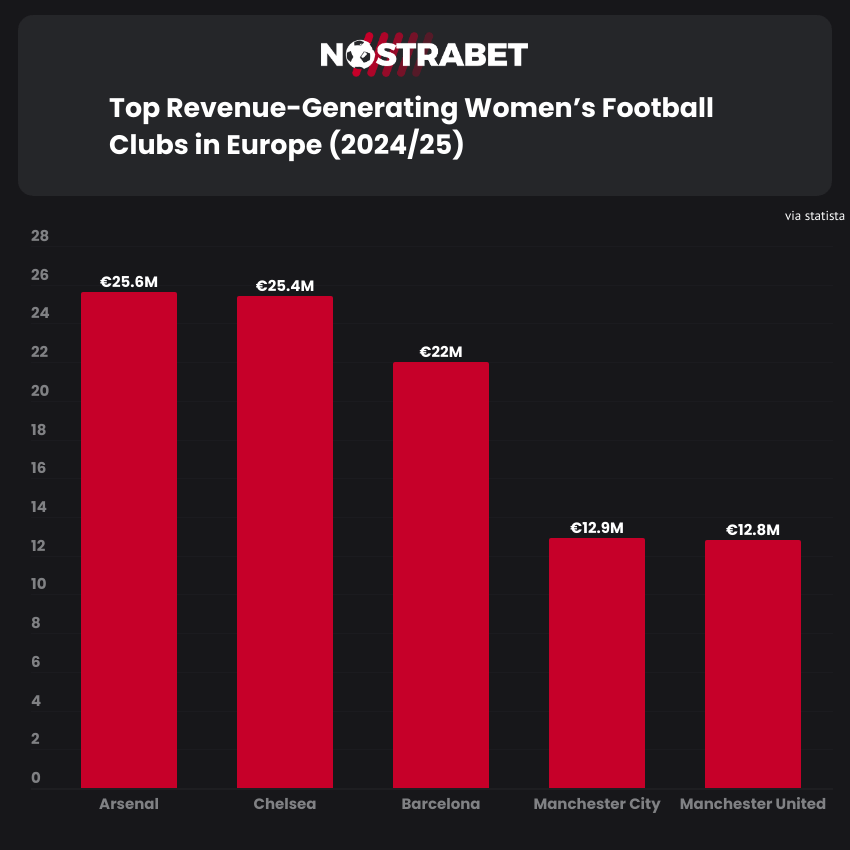
The stats that we found on Statista show that the 2024/25 season for women’s football in Europe was very interesting. A quick look at tube revenue reveals that it ranged from €4.7M to €25.6M on the high end. Clubs from England dominated the upper end of the ranking. In fact, Arsenal Women is first with €25.6M, followed by Chelsea Women with €25.4M and Barcelona Femeni with €22M.
We believe the concentration is not accidental because all three top clubs share common traits. They have a tight integration with elite men’s clubs, and this allows them easy access to marketing, sponsor portfolios and infrastructure. On top of that, all of these teams take part in storing domestic league and international events. You can find them in the UEFA Women’s Champions League, an event that boosts exposure and prize money.
An important thing to know is that the gap between the top clubs and those ranked lower is dramatic. This is a clear sign that women’s football still operates in a compressed financial ecosystem.
Revenue is important because it determines player wagers, training facilities, and many other things. Some stats reveal that the average annual salary for an elite women’s footballer in Europe is around €50,000. This is substantially lower than what some of the top-tier male footballers earn.
Matchday Revenue – Tickets, Attendance and Stadium Strategy
We know that you want to know how women’s football teams earn their revenue, so we’ll begin with the first thing: ticket sales.
On matchday, fans who want to support their favorite clubs buy tickets to watch the game. Aside from the tickets themselves, in-stadium spending is also a minor revenue stream in women’s football.
A quick look at average ticket prices in women’s leagues shows they range from €5 to €15. This is substantially lower than those for men’s matches, which reach up to €80 and above. It seems like clubs prioritize accessibility and attendance instead of short-term margins.
Given these ticket prices, we feel the matchday revenue accounts for a relatively small share of total income. We guess that it’s no more than 20%, even for elite women’s clubs.
Choosing the right stadium to play on is an important decision for the financials of women’s clubs. Using a larger stadium creates global visibility but also has high operating costs. Small ground, on the other hand, offers a better atmosphere but has a cap on the potential revenue.
Broadcasting and Media Rights – The Revenue Stream that Matters More

Most people know that broadcasting is the main revenue driver in men’s football and can often reach 60% of the club’s total income. Considering these numbers, we were not surprised that it is also a major contributor to women’s football.
We do not have access to the exact numbers for every team, but a quick research shows that the English FA had a 24M GBP deal with two domestic media groups for the WSL. This happened in 2021, and it was the league’s first paid TV contract. This definitely increases the baseline income and sponsor appeal for clubs that are a part of it.
Something you should keep in mind is that women’s media rights are often valued more for reach than immediate cash. In other words, clubs are willing to “sacrifice” their revenue so that they can capture a wide audience in the long run.
Based on stats from UEFA from 2023, more than 365 million people watched the Women’s Champions League Final. This number is really impressive, and it drives commercial revenue indirectly by increasing sponsorship valuations. Speaking of sponsorships, this is the next thing we’d like to discuss.
Sponsorships and Commercial Partnerships
After a detailed analysis, we believe that the sponsorships are the most significant revenue stream for most elite women’s clubs. What’s different here is that women’s football offers brand category exclusivity and positive brand association. In other words, clubs value these deals and rely on them to generate a lot of revenue.
Today, you can find many football clubs that have standalone sponsorship deals for their women’s teams. Barcelona Femeni is a good example because the team works alongside Spotify. The latter appears on both the men’s and women’s teams and signs a parity in brand value. Chelsea Women is another good example because it has a three-year commercial partnership that specifically includes the women’s team.
Some studies show that women’s sports deliver higher engagement per follower on social media than men’s sports. It seems like this is really the case because the sponsorship revenue in women’s football is growing at a double-digit annual rate. Yes, the absolute value remains lower than that for men’s football, but the growth is still impressive.
Commercial Revenue Beyond the Pitch

Aside from everything mentioned so far, we also believe that merchandise sales are important in women’s football. This was definitely not a major factor before, but nowadays, things are changing. Many of the popular shirts of star players sell out frequently, especially before big events.
Just to get an idea, Nike made a report following the 2019 Women’s World Cup that women’s football shirt sales jumped by 300%. Considering this was 7 years ago, we can only imagine what will happen in a few years. Sure, the overall volumes remain limited compared to men’s football, but this is not surprising.
As mentioned earlier, social media has a huge role in women’s football, so clubs try to take full advantage. Many clubs leverage platforms like TikTok, YouTube and Instagram so that they can reach global audiences. These things help them a lot because they do not need to rely on traditional broadcasters.
Some studies show that women’s football fans are 34% more likely to engage with branded digital content than average sports fans. This creates a lot of monetization opportunities through content rather than traditional advertising.
Women’s and Men’s Football Revenue Comparison
The revenue for men’s football is truly on another level when you compare it to that of women’s. During the 2022/23 season, Real Madrid broke all records by surpassing €1 billion in annual revenue. This number is jaw-dropping, but even the average Premier League club generates over €300 million annually. Needless to say, men’s clubs dwarf even the top women’s teams.
There are many reasons for the huge gap between the two. For starters, men’s football benefits from decades of commercial accumulation. It also has a global broadcast monopoly and established gambling and betting markets. When it comes to women’s football, however, it is building a commercial ecosystem from scratch.
The fact that women’s football is behind in revenue means that it’s growing much faster than men’s football. Some stats show that the rate is around 20 to 30% annually, whereas men’s football grows in the single-digits.
Financial Sustainability and the Future Business Model
It’s no surprise that most women’s teams continue to operate at a loss, despite the increase in revenue. They will continue to rely on cross-subsidization from men’s clubs.
Many analysts believe that the best women’s football clubs will eventually reach €100m in annual revenue. This will happen primarily thanks to different sponsorship deals and media growth rather than ticket sales.
We also believe that women’s football clubs need to pay more attention to the online betting industry. People love betting on football, and it is the most popular sport, so catering to them should have a big impact on their popularity. Even though the industry is way more advanced than before, you can still find a lot of top-tier sports betting platforms that do not offer that many options for women’s sports, including football.
Conclusion
A lot of people assume that women’s football is a smaller version of the men’s game. We believe this is not the case because it operates in a different way, especially when it comes to finances.
Women’s football prioritizes engagement, long-term brand value and accessibility over immediate profit maximization. This explains why some of the top European football teams generate just €25 million per year, compared to over €1 billion for clubs like Real Madrid.
We believe women’s football is slowly positioning itself as a parallel market to men’s football. It has its own rules, values, and economic strengths, so we can’t wait to see what it will look like in the near future.

No comments added yet. Be the first!